How to Prepare a Label Roll for Automatic Labeling Machines?
We cover label roll preparation for automatic labeling machines: roll and winding direction, core diameter, roll outer diameter, winding tension, gap and die-cut, layout, black mark and sensor marks, liner and application speed, plus a pre-order checklist.
On automatic labeling machines (labelers/applicators), smooth production depends as much on how the roll is prepared as on the label itself. When the roll direction, winding type, core diameter, gap between labels and sensor marks are not compatible with the machine, the line stops, labels apply crooked, or the liner tears. The good news is that most of these problems can be prevented at the ordering stage if the parameters are defined correctly. This article covers the technical framework of roll preparation for automatic labeling machines, what information should be requested from the machine and the manufacturer, and the mistakes that are made most often.
A note up front: values such as core diameter, maximum roll outer diameter, gap tolerance and winding direction vary from machine to machine and from application to application. The ranges and examples given here are only general guidance; always confirm with the machine manufacturer or your in-house technical team for your own line. Working with verified parameters rather than invented ones is critical for line continuity.
How does a roll work on an automatic labeling machine?
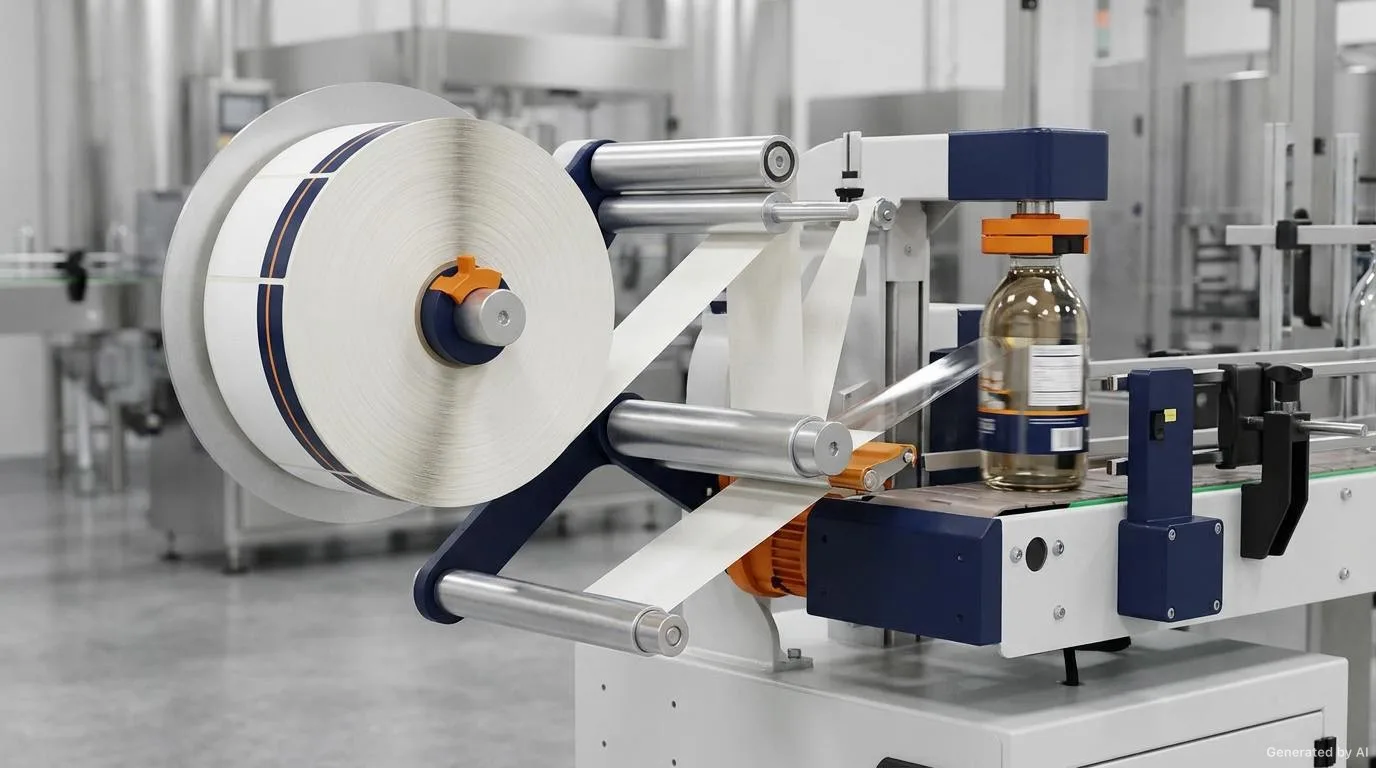
A typical automatic labeling machine follows this cycle: the spool unwinds on the unwinder, the carrier liner runs through rollers and is guided over a peel plate or blade. Here the label separates from the liner and is applied to the product by the applicator (pad/tamp, roller, belt or blow-on). The spent liner is then wound up on the rewinder. Every step in this chain is linked by tension, and the roll's geometry and direction sit at the very beginning of the chain.
The second critical point is the machine's feeding and detection steps. Machines usually determine where a label starts with sensors: they read either the gap between labels or a printed mark called a black mark. If the sensor does not read correctly, the feed amount drifts; the label either separates too early or stays half-attached. So roll preparation is not only about a neatly wound spool; it is also about geometry that matches the machine's reading system.
Roll direction and winding direction
The roll direction determines from which side the spool unwinds on the machine and in which direction the label separates from the liner. Two rolls that look identical cannot be used at all on the machine if they are wound the wrong way. So when ordering, treat direction not as an abstract preference but as a technical requirement that must be clearly defined.
Inside wind and outside wind
Rolls can generally be prepared as inside wind (outward from the core) or outside wind (inward toward the core). Which one is required depends entirely on the machine's unwind direction. Whether the label face looks outward or inward relative to the liner directly affects the direction in which the label separates at the peel edge. If this distinction is made incorrectly, the label separates in the opposite direction and cannot be applied.
Direction in which the label peels from the liner
In practice, terms like “right direction”, “left direction” or “counter-clockwise” are used often, but they can be misread depending on the machine and the point of view. The most reliable method is to define the roll with a diagram or photo where possible, and to actually test the direction on the first sample print. If possible, send a sample of a currently working roll to the supplier; the direction is then clarified beyond doubt.
Core diameter, roll outer diameter and winding tension
The core diameter is the size at which the roll fits the machine shaft and forms the center of the spool. If the core diameter does not match the machine shaft, the roll either will not mount or will wobble. A small core also means more winding turns at the same thickness and a tighter curvature, which on thin materials can cause the label to ripple around the core or lift at the edge. For this reason, the core diameter should be taken from the machine specification.
The roll outer diameter is limited by the capacity of the machine's roll bay and unwinder arm. As the diameter grows, the same roll holds more labels, giving longer runs with fewer roll changes. But a large, heavy roll can stress the machine's unwinding tension and drive system. The balance point sits between the maximum diameter the machine allows and line efficiency.
Winding tension is how tightly the roll is wound. Too loose a wind causes slipping, folding and crooked feeding during unwinding. Too tight a wind can cause the adhesive (especially with soft adhesives) to ooze from the edge and make the label hard to separate from the liner. The correct tension is a production parameter that should be set according to material type, label size and application speed.
Gap between labels, die-cut and repeat length
The gap between labels is the area where the machine's sensor detects the label transition. A consistent gap is essential for stable feeding. Die-cut means the cut is completed only in the label layer so the label can be peeled from the liner, while the liner itself is not cut. If the liner is partly cut, it tears during pulling and the line stops. So the die-cut quality and liner integrity of the roll are things to check on incoming material.
Repeat length is the distance from the start of one label to the start of the next, including the label length and the gap. The machine's feed setting is made according to this repeat length. If rolls with different repeat lengths are mixed on the same line, the feed drifts. Rolls ordered for one job should therefore have a consistent repeat length and gap.
Single-row/multi-row layout, black mark and sensor marks
Labels on a roll can be arranged in a single row (single column) or in multiple rows (several columns). A multi-row layout feeds more than one label at a time and can raise efficiency, but the machine must be suited to this layout and the sensor must read the correct column. The layout choice is directly related to the machine's applicator head and the label width.
Some machines feed by black mark instead of gap. A black mark is a mark printed on the back of the liner or between labels that the sensor can read. The position, size and darkness of the sensor mark must suit the machine's optical system. If the two detection types (gap and black mark) are mixed up, the sensor either never triggers or triggers unreliably. When ordering a roll, state clearly which detection method the machine uses.
The liner and the effect of application speed
The carrier liner is the base to which the label temporarily adheres and from which it separates at the peel edge. The liner's thickness, stiffness and release properties determine the application behavior. A very stiff liner can behave brittle and break at high speed; a very soft liner can fold in the guide rollers. How easily the liner releases the label also matters: a liner that releases poorly can snag on the line, while one that releases too easily can let the label separate early and apply crooked.
Application speed is an invisible variable in roll preparation. As speed increases, the angle and time at which the label separates from the liner change, and the adhesive has less time to bond to the product. On high-speed lines, tension, liner release value and die-cut precision therefore become even more important. The same roll may run without issues at low speed but cause problems at high speed, so testing at the real production speed is recommended.
Machine type and roll requirements
The table below summarises the points that stand out on the roll side for different machine and application types. The table is general guidance; the exact requirement of each machine should be taken from the manufacturer's specification.
| Machine / application type | Main focus | Watch on the roll side |
|---|---|---|
| Desktop / semi-automatic | Low–medium speed | Core diameter, gap tolerance |
| Fully automatic applicator (pad/tamp) | Medium–high speed | Direction, tension, sensor mark |
| Roll type (wrap-around) | High speed | Winding tension, roll outer diameter, liner stability |
| Blow-on | High speed | Label stiffness, peel direction |
| Print & apply | Varies | Sensor mark, gap, direction |
Technical information to request from the machine manufacturer or supplier
The safest way to order the right roll is to collect the information from the machine side completely. The list below gathers the headings that should be clarified before ordering.
- Core diameter: the core size that matches the machine shaft (confirmed by the manufacturer).
- Maximum roll outer diameter: the largest diameter and weight the unwinder bay accepts.
- Winding direction: whether an inside or outside wind is required.
- Unwind direction: the direction in which the label separates from the liner.
- Detection method: whether feeding is by gap or by black mark.
- Application speed range: the real speed at which the line runs.
- Label and liner width: to match the applicator width.
- Repeat length and gap: dimensions that fit the existing working product.
- Material and adhesive type: for compatibility with surface, temperature and product.
- Sample request: a sample roll for testing before a large order.
Pre-order roll preparation checklist
Checking the following points one by one before starting a new job prevents most line stoppages.
- Do we have the machine model and the manufacturer's specification?
- Have the core diameter and maximum roll outer diameter been confirmed?
- Are the winding direction (inside/outside) and unwind direction clear?
- Is the detection method (gap or black mark) and mark dimension specified?
- Are the label length, gap and repeat length dimensions consistent?
- Is the single-row/multi-row layout compatible with the machine?
- Are the liner type and release property suited to the application speed?
- Is the adhesive compatible with the product surface and temperature conditions?
- Is post-print protection (lamination etc.) required?
- Has a sample been tested before the large order?
Common mistakes
The following mistakes account for most line stoppages and quality issues in automatic labeling.
- Ordering without specifying direction: the roll does not fit the machine; the fix is to define the direction with a sample or diagram.
- Assuming the core diameter: a shaft mismatch makes the roll unusable.
- Mixing up gap/sensor methods: the feed drifts and the label peels halfway.
- Not setting winding tension to speed: slipping or oozing appears at high speed.
- Ignoring the liner: a weak liner breaks or folds at high speed.
- Skipping the sample test: the problem only appears on the production line, at higher cost.
A realistic scenario: food and beverage filling line
Consider a beverage producer bottling fruit juice. The filling line runs at a certain speed and labels arriving on rolls are applied to the bottles by a fully automatic applicator. On the first run the labels separate neatly; but mid-shift, after a roll change, the labels begin to apply crooked and the liner sometimes tears. On inspection it turns out the issue is not direction: the outer diameter of the new rolls stresses the unwinder arm, and the tension is too tight for the line speed. The producer talks to their supplier and reviews the core diameter, maximum outer diameter, winding tension profile and liner type together; a sample roll is tested at the real production speed. With the adjustments, labels now apply consistently throughout the shift and, because roll changes are fewer, line efficiency improves as well.
This scenario shows that even a single parameter can stop the line, and that the solution is to collect the right information from the start and confirm it with a sample.
Conclusion and practical recommendations
Preparing a roll that suits an automatic labeling machine is a combination of technical decisions: roll and winding direction, core diameter, roll outer diameter, winding tension, gap and die-cut, layout and sensor mark, liner type and application speed. The exact values of these parameters vary with the machine and application, so the most robust approach is to base everything on the machine specification and test with a sample before a large order.
For a broader view, see our articles on what to know before ordering label rolls, choosing the right adhesive in how to choose a label adhesive, material choice in coated paper versus film labels, and variable data jobs in variable data printing and serial-numbered labels.
Let us prepare the right roll for your line together
Every machine has a different core diameter, winding direction and sensor requirement. Share your machine model and a sample of your current roll; we will define the roll parameters and sample option that suit your automatic labeling machine. You can browse our range on the products page, or reach us through the request a quote page for a quick assessment.
Frequently Asked Questions
How should I define the roll direction?
The most reliable way is to follow the machine manufacturer's specification and, if possible, send a working roll sample to the supplier. Terms like “right/left direction” can be misread, so clarify with a diagram, photo or sample.
Why does core diameter matter?
The core diameter is the size at which the roll fits the machine shaft. A mismatched core makes the roll impossible to mount or causes it to wobble, so it should be confirmed from the machine specification.
What is the difference between gap and black mark?
The gap is the open space between labels, which the sensor detects. A black mark is a printed mark the sensor reads. The roll must be prepared according to the method the machine uses.
Why do labels apply crooked at high speed?
As speed increases, the time the label takes to peel from the liner changes and the adhesive has less time to bond. If winding tension and liner release are not suited to the speed, slipping can occur. Test parameters at the real production speed.
Is a sample roll necessary?
Testing a sample before a large order confirms that direction, tension and sensor compatibility work on the line without problems. It is recommended to avoid line stoppages and material waste.
Want to Determine the Right Label for Your Product?
Share your usage area and needs with us; let's evaluate suitable options together.