Shelf Life and Storage Conditions for Labels
We cover the shelf life and storage of labels: how the adhesive behaves over time, temperature and humidity, UV protection, ideal storage conditions, stacking, acclimatisation and the signs of ageing.
From the moment a label roll is delivered, it may look ready to use, but it does not have an unlimited shelf life. The adhesive, the material and the print change slowly but inevitably with temperature, humidity, light and time. Proper storage preserves a label's print quality, adhesion performance and ease of application, while poor storage leads to rolls that fail before use, adhesive ooze and production losses.
In this article we cover the shelf life and storage conditions of labels: how the adhesive behaves over time, the effect of temperature and humidity, protection from UV and sunlight, the effect of dust, dirt and chemical vapour, ideal storage conditions, vertical/horizontal stacking and roll deformation, use of opened rolls, acclimatisation before use, expiry date and batch tracking, signs of deterioration and the risks of using old labels. The aim is to offer a practical framework to improve your warehouse and handling habits.
What does shelf life mean for labels?
Shelf life is the period during which a label, from the moment of production, keeps its properties under ideal storage conditions. This period depends on the type of material, the chemistry of the adhesive, the printing method and, above all, the storage conditions. A single fixed duration therefore cannot be given for all labels; the relevant period varies with the manufacturer's data.
A label's shelf life is determined not only by "how much time has passed" but by the temperature, humidity and light it is exposed to during that time. A roll that stays problem-free for years in a cool, dry warehouse can lose its adhesion in the same period in a hot and humid environment. Shelf life should therefore be seen as a value read together with storage conditions, not as a calendar duration alone.
How does the adhesive behave over time?
Modern label adhesives are pressure-sensitive systems: they are only lightly tacky under normal conditions and bond to the surface with the pressure and temperature applied during application. Time and ambient conditions change this balance. Two opposing processes stand out: the adhesive softening and flowing, and the adhesive drying and hardening.
In a hot environment the adhesive softens and becomes more fluid; this can lead to adhesive oozing from the roll edges (adhesive ooze/bleed). In a cold or very dry environment the adhesive hardens, its holding power drops and lifting or edge curl can appear during application. Both extremes impair the label's function.
The effect of temperature and humidity
Temperature is the factor to which the adhesive is most sensitive. High temperature softens the adhesive and increases the risk of oozing and roll blocking (layers sticking to each other). Extreme temperature swings cause expansion and contraction in the material, which can harm print registration and roll tension. At low temperatures the adhesive temporarily loses holding power; however, once it returns to room temperature it usually approaches its former performance.
Humidity is at least as important as temperature. High humidity can cause waviness, curling and dimensional change in paper-based labels and loss of adhesion in some adhesives. A very dry environment, on the other hand, generates static electricity and attracts dust, soiling the surface. Ideal storage therefore requires a balanced environment in terms of both temperature and humidity.
Protection from UV and sunlight
Direct sunlight and strong UV are harmful to a label in several ways. Colours fade on the printed surface; especially in direct thermal labels, heat and light can cause the print to darken or fade. UV also degrades the chemical structure of the adhesive and the material surface over time. Keeping rolls directly in front of a window or on sunlit shelves accelerates this process.
Label rolls should therefore be stored in closed cabinets that receive no direct sunlight or in light-blocking packaging. If they are left on open shelves, they should be covered and not exposed to sunlight for long periods.
Dust, dirt and chemical vapour
When the adhesive face of a label roll is left exposed, it picks up dust and dirt. This contamination reduces adhesion during application and can soil print heads or machine parts. Rolls waiting in a dusty warehouse can accumulate particles on the surface even before being opened.
Chemical vapour is another often overlooked risk. In environments containing solvent, paint, cleaning product or battery vapour, the adhesive and material of stored labels can degrade over time; paper yellows, film dulls and adhesion properties can change. Label rolls should be kept away from areas where chemicals are stored.
Ideal storage conditions and comparison table
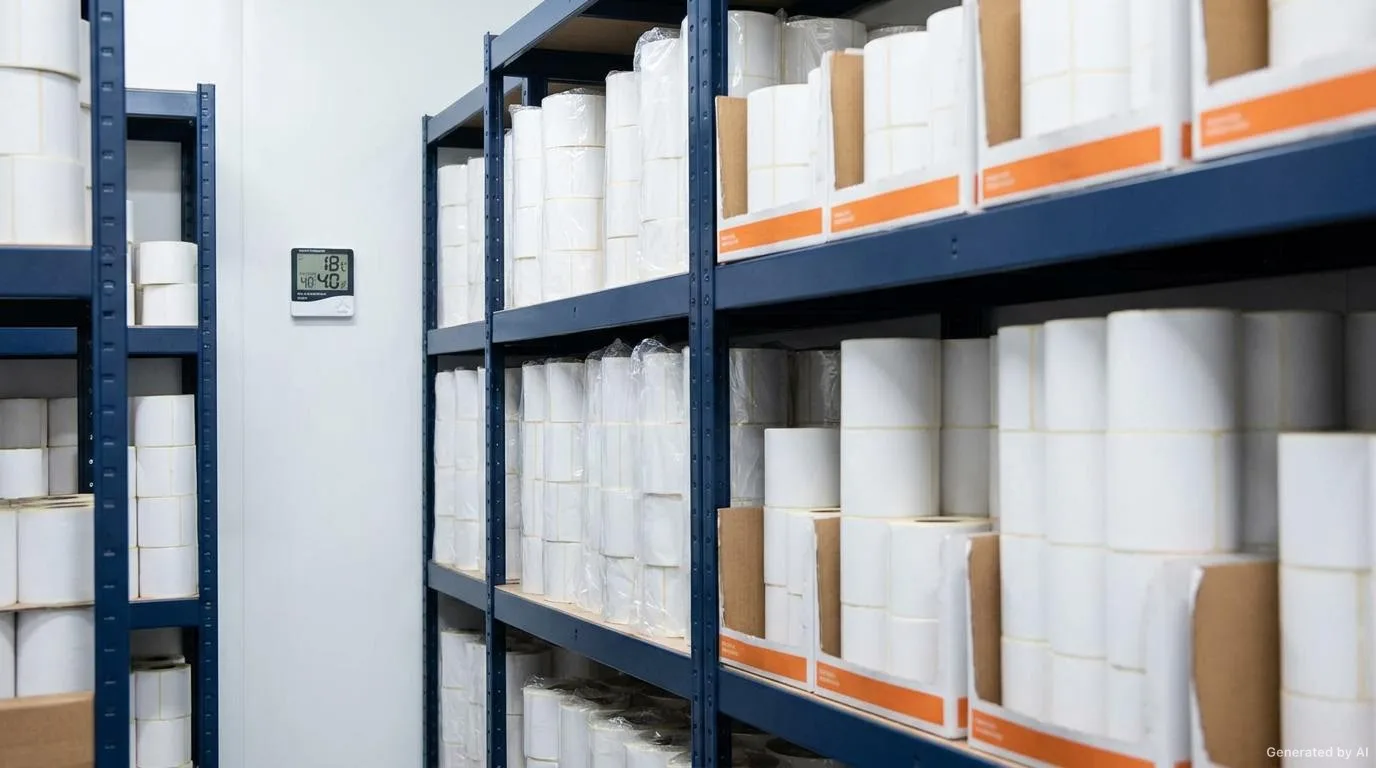
The ideal storage environment for labels is generally a cool, dry place with no direct sunlight. A warehouse protected from extreme temperature, high humidity and UV extends the life of both the adhesive and the material. The table below summarises the effect of each condition and general recommendations; exact ranges vary with product type and manufacturer data.
The key features of an ideal label warehouse can be summarised as follows:
- A cool and reasonably stable temperature
- Low and balanced humidity
- A dark or shaded area with no direct sunlight
- An environment away from dust and chemical vapour
- Balanced, supported stacking without excessive pressure
- A clean and tidy rack arrangement
| Storage factor | Suitable / ideal | Risky | Possible outcome |
|---|---|---|---|
| Temperature | Cool and stable | Too hot or too cold | Adhesive ooze, blocking or loss of adhesion |
| Humidity | Protected and balanced | High humidity / wet floor | Waviness, curling, adhesion loss |
| Light | Dark cabinet or closed packaging | Direct sun / strong UV | Colour fading, adhesive degradation |
| Dust / dirt | Clean, dust-free area | Dusty or dirty warehouse | Weak adhesion, printer soiling |
| Chemical vapour | Separate, ventilated area | Exposure to solvent/paint vapour | Yellowing, dulling, loss of properties |
| Stacking | Balanced, supported upright | Excessive flat stacking / pressure | Roll crushing, ovality, ooze |
Vertical and horizontal stacking: roll deformation
How roll labels sit directly affects their life. Rolls standing in balance and with support (usually upright or on a suitable rack/support) keep the shape of the roll body. Excessively high stacks crush the lower rolls and turn the circular form oval, causing feeding problems in the labelling machine.
Rolls laid horizontally for a long time under stacked pressure can ooze adhesive from their edges or have layers block together. Rolls should therefore be stacked with their weight evenly distributed, without excessive pressure and as recommended by the manufacturer. Supported shelves or special stands are preferred for large rolls.
Using opened rolls
Once a roll is opened it is no longer fully protected from external factors. The exposed adhesive face collects dust and is affected by moisture. Partly used rolls should therefore be returned to protective packaging or covered with a moisture-resistant cover when not in use.
Consuming opened rolls as soon as possible ensures they are used before ambient conditions affect them. Rolls left open for a long time more often show adhesive ooze or loss of adhesion. Noting the date of use on partial rolls shows which roll should be consumed first in future.
Acclimatisation before use (bringing to room temperature)
Label rolls should be brought to the temperature of the environment where they will be used before being opened. This process is called acclimatisation. A roll taken from a cold warehouse and placed directly into a warm production environment can form condensation; the moisture that forms on the surface harms adhesion and print quality.
Rolls should therefore be brought into the usage environment and left (with the packaging closed) for a certain time to reach room temperature, after which the packaging is opened. The exact waiting time varies with roll size, temperature difference and the manufacturer's recommendation. The aim is both for the adhesive to regain its natural performance and for no condensation to form on the surface.
Expiry date and batch tracking
Expiry date and batch (lot) information also matter for label rolls. The service period stated in the manufacturer's data applies when ideal storage conditions are met. Batch tracking makes it easier to identify which production group is affected in the event of a problem.
Applying a first-in-first-out (FIFO) approach in the warehouse prevents old batches from being left behind and products exceeding their shelf life from accumulating. Noting the delivery date and opening date on the rolls is a practical tracking method.
Signs of deterioration and their causes
It is often possible to see that a label roll is starting to deteriorate before it is used. The signs below point to problems with storage conditions. When a sign appears, the relevant batch should be assessed separately and, if necessary, discussed with the manufacturer.
| Sign of deterioration | Likely cause | How it is noticed |
|---|---|---|
| Adhesive ooze (edge/layer) | High temperature, excessive stacking pressure | Wet, sticky mark on the roll edge |
| Layers blocking together | Temperature + pressure, humidity | Layers are hard to separate when opening the roll |
| Drying / loss of adhesion | Very dry environment, long storage | Label sticks poorly, corner lifts |
| Yellowing / colour fading | UV, sunlight, chemical vapour | Paper yellowed, print faded |
| Waviness / curling | High humidity | Paper label surface is wavy |
| Dusting / staining | Left open, dirty environment | Visible particles/stains on the surface |
The risks of using old labels
Using labels that have exceeded their shelf life or been poorly stored may look like cost saving at first glance, but it can cause serious problems in production. Labels with reduced adhesion may not stick to the product packaging, causing stoppages on the labelling line, re-labelling and customer complaints.
Deteriorated adhesive also leaves residue on print heads and machine parts, increasing maintenance cost. Visually yellowed or faded labels weaken the product's perception on the shelf. It is therefore safer to test doubtful batches on a sample before use and, if necessary, dispose of them.
Storage and control checklist
- Is the warehouse a cool, dry space with no direct sunlight?
- Is it protected from extreme temperature and humidity swings?
- Are rolls kept separate from areas where chemicals and vapour are stored?
- Is the warehouse kept clean and dust-free?
- Are rolls stacked in balance, with support and without excessive pressure?
- Are opened rolls reclosed and consumed soon?
- Are rolls brought to room temperature before use (acclimatisation)?
- Are expiry date and batch information tracked?
- Is a first-in-first-out (FIFO) rule applied?
- Are adhesion and print quality checked before use?
- Are doubtful rolls set aside and assessed?
- Are delivery and opening dates noted on the rolls?
A realistic scenario
A mid-sized food producer ordered a large quantity of roll labels before the busy season and kept them in a sunlit area close to the production line. At the start of the season it was noticed that adhesive oozed from the edges of some rolls and that the label layers were hard to separate. There were feeding problems on the machine, and some labels did not stick fully to the bottles.
The producer moved the rolls to a cool, dry warehouse with no direct sunlight, defined a waiting time for acclimatisation before use and started FIFO tracking. The problems largely decreased in the new batch. This example shows that a label's quality is determined not only by production but also by storage and handling habits after delivery.
Conclusion and practical recommendations
A label's shelf life is directly related to its storage conditions. A cool, dry, dark and clean environment; balanced stacking; protection of opened rolls; acclimatisation before use; and regular batch tracking preserve the label's performance and reduce production losses. Exact times and ranges vary with product type and manufacturer data, so it is best to base decisions on your supplier's recommendations.
To support your storage and material decisions, see our articles on how to choose a label adhesive: surface and use conditions, labels resistant to water, moisture and outdoor conditions, what to know before ordering roll labels and lamination and protective coatings for labels.
Let us assess your storage conditions together
Knowing under what conditions your labels are stored and how long they wait makes it easier to choose the right material and adhesive. Share your product type and storage conditions, and we will determine together the suitable label and storage approach. You can browse our range on the products page, or reach us through the request a quote page for a quick assessment.
Frequently Asked Questions
How long is a label's shelf life?
It varies with the product type, adhesive and storage conditions; the manufacturer's data should be the basis. In a cool, dry place with no direct sunlight the life is noticeably longer.
Should label rolls be stored in a refrigerator?
Generally not recommended; cold hardens the adhesive and creates a condensation risk. A cool, stable environment is preferred over extreme temperature swings.
Why does adhesive ooze happen?
It is usually caused by high temperature and excessive stacking pressure. Rolls should be stored in a cool place, in balance and without excessive pressure.
How long can an opened roll be used?
An opened roll becomes exposed to dust, moisture and light; it should be consumed as soon as possible and covered when not in use. The exact time varies with the product and environment.
Do rolls need to rest before use?
Yes. A roll taken from a cold warehouse and left to reach room temperature in the usage environment prevents condensation and lets the adhesive regain its natural performance.
Want to Determine the Right Label for Your Product?
Share your usage area and needs with us; let's evaluate suitable options together.